The question sounds simple. Who is buying Maltese property? The answer, when you sit with the data from Parliament, is not what most people on this island would guess. It is not British retirees. It is not European families relocating for work. It is predominantly Chinese capital, acquiring residential property at a rate that has quadrupled in three years. And the government knows, because it published the numbers itself. It just refuses to connect them to the crisis outside your door.
The Numbers Parliament Published
In January 2026, Finance Minister Clyde Caruana answered a parliamentary question with data that should have dominated headlines for a week. It barely survived a news cycle.
The figures cover Acquisition of Immovable Property (AIP) permits, the permission non-EU citizens need to buy residential property outside Special Designated Areas. They are the closest thing Malta has to an official count of foreign investment in housing.
The trend is unambiguous:
| Year | Total AIP Permits (all non-EU) | Chinese Nationals | Share |
|---|---|---|---|
| 2021 | 379 | 83 | 22% |
| 2022 | ~500 | ~200 | ~40% |
| 2023 | ~650 | ~250 | ~38% |
| 2024 | 777 (peak) | 350+ | ~45% |
| 2025 | 703 | 350+ | ~50% |
Over five years, Chinese nationals accounted for more than 1,090 AIP permits, close to 40 per cent of all permits issued. No other nationality comes close. British buyers, historically the dominant foreign presence in Maltese property, held steady at around 50 per year. Indian nationals grew to about 60 annually. Serbian, Turkish, and Ukrainian buyers appear in smaller numbers.
This is not a diversification of demand. It is a concentration.
The SDA Black Hole
Here is the problem with treating those numbers as the full picture. They are not.
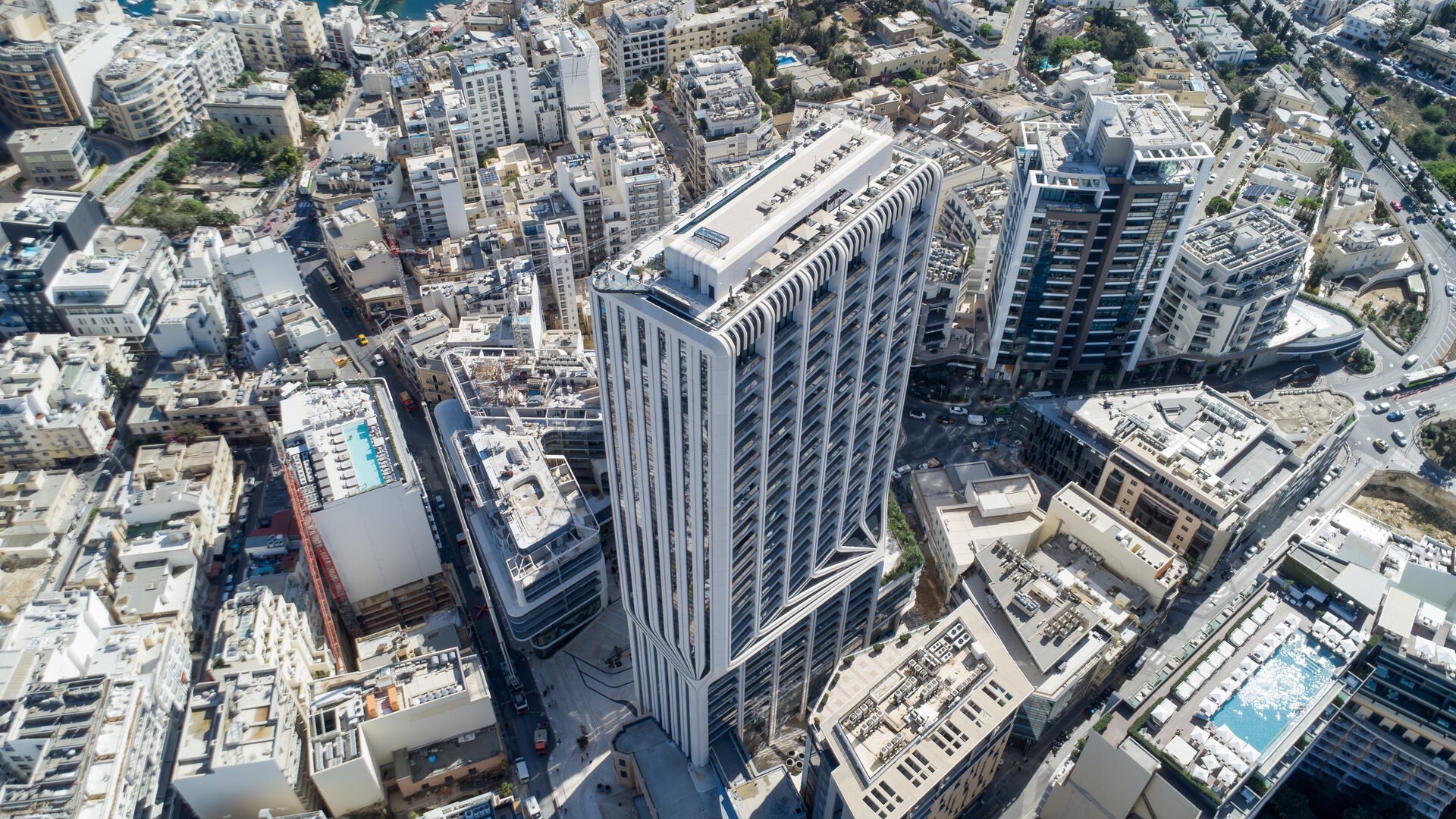
Most foreign buyers in Malta do not need an AIP permit at all. Properties inside Special Designated Areas, the high-end developments that ring the coast, are exempt. Mercury Towers, Shoreline, Tigne Point, Pendergardens, Portomaso, all the landmarks of Malta’s vertical turn. Buyers of any nationality can purchase freely inside these zones with no permit, no cap, and no record in the AIP data.
The parliamentary figures Caruana tabled capture only the properties bought outside SDAs. The luxury apartment towers where the bulk of foreign capital actually lands are invisible in these statistics.
So when you read that 350 Chinese nationals bought property in Malta in a single year through the AIP route, remember that the number sitting on top of that, inside the SDAs, is comfortably higher. We do not know by how much, because the government does not publish SDA acquisition data by nationality. Whether that omission is deliberate is a question worth asking.
Investment, Not Homes
There is a distinction that matters more than nationality. It is the difference between buying a property to live in and buying a property as a financial instrument.
British retirees who buy a flat in Marsascala or Mellieha tend to move here. They shop at the greengrocer. They join the parish. Their consumption stays in the local economy. They are residents.
The dominant pattern in the AIP data tells a different story. These are investment acquisitions. Capital parking. Wealth diversification into EU-denominated real estate on an island with no annual property tax, no capital gains on sale after five years of holding, and a AIP permit fee of €233.
€233. That is what Malta charges a non-EU buyer for the privilege of acquiring residential property. The administrative cost of processing the paperwork probably exceeds the fee.
The AIP permit fee has not been meaningfully updated in years. For context: the 2026 minimum property values required for an AIP purchase are €174,274 for a flat or maisonette and €300,619 for other property types. On a €300,000 purchase, the permit fee represents 0.08% of the transaction value.
The result is predictable. Property becomes a savings account for people who do not live here. Units sit empty, or enter the short-term rental market, or wait for capital appreciation. They occupy space in a housing stock that is already insufficient for the people who actually need a home on this island. Every investment purchase that does not house a resident is a home subtracted from the market.
The Golden Passport Pipeline
The foreign investment story does not start with AIP permits. It starts, for many buyers, with citizenship.
Malta’s Citizenship by Naturalisation for Exceptional Services by Direct Investment programme, the successor to the original Individual Investor Programme, requires applicants to either purchase a residential property worth at least €700,000 or rent one at a minimum of €16,000 per year, held for five years.
That €700,000 floor has funnelled substantial CBI money directly into Maltese real estate. Properties purchased through the programme sit in the same housing stock, compete for the same land, and contribute to the same price pressures as every other unit. The difference is that the buyer’s primary motivation is a passport, not a home.
The European Commission challenged Malta’s CBI framework in court. The programme was restructured and rebranded. But the property pipeline remains. And the buyers who came through the original scheme, and its successor, are now part of the ownership landscape, holding units that may or may not be occupied, in a market where Maltese families cannot find a place to rent at a price they can afford.
What Other Countries Do
Malta is not the only small island with a hot property market and foreign demand. It is just the one doing the least about it.
Singapore, a country with a comparable land scarcity and a comparable appeal to global capital, charges foreign buyers an Additional Buyer’s Stamp Duty of 60% of the property value. On a €300,000 apartment, that is €180,000 in tax alone, payable at point of purchase. On a €700,000 CBI-threshold property, it would be €420,000.
Malta charges €233.
The contrast is not subtle. Singapore treats residential property as a strategic national asset and prices foreign speculation out of the market. Malta treats it as a revenue stream for the property sector and a perk for the investment-migration industry.
| Jurisdiction | Foreign Buyer Levy | On a €300,000 Purchase |
|---|---|---|
| Malta (AIP permit fee) | Flat €233 | €233 |
| Singapore (ABSD, foreign buyers) | 60% of value | €180,000 |
| Australia (Foreign Investment Review Board fee) | Tiered, up to | €60,000-€100,000+ |
| Canada (Underused Housing Tax + provincial levies) | 1% annual + up to 20% provincial | €3,000/year + up to €60,000 |
No one is suggesting Malta copy Singapore’s model wholesale. But the principle is sound: if you want to keep housing affordable for the people who live and work in your country, you cannot let foreign capital buy residential property at a fee of €233 and call it a free market.
Empty Units, Full Crisis
Foreign investment purchases compound the housing crisis through a second channel: vacancy.
When a Maltese family buys a home, they live in it. When a local investor buys a second property, they typically rent it long-term to another resident. When overseas capital buys a property, especially through a permit system that explicitly bars the buyer from renting it out on the AIP track, the unit often sits vacant. The owner does not live in Malta. The unit is not their home. It is a store of value.
Malta has no annual property tax. There is no holding cost for keeping a unit empty. There is no vacancy tax. There is no useful enforcement mechanism to distinguish an empty investment unit from an occupied home. And the government has shown no interest in introducing one.
Every empty foreign-owned unit is a home that does not exist in the effective supply. It has a door, a roof, a kitchen. It does not house anyone. In a market where 24,000+ households are in housing stress, that is not a neutral outcome. It is a policy choice.
What Government Says vs What Government Does
Minister Caruana tabled the AIP data in Parliament. That is where the transparency ends.
The numbers are published. The analysis is absent. No minister has connected the surge in foreign property acquisition to the rental crisis. No policy response has been proposed. The SDA exemption remains untouched. The €233 permit fee remains untouched. The absence of a vacancy tax remains untouched.
The official position is that Malta’s housing crisis is a matter of supply and demand, and that the market will correct itself. But this framing omits the most important variable: government is the largest single actor shaping both supply and demand. It sets population policy. It grants planning permits. It designates SDAs. It sets the AIP fee. It runs the CBI programme. It decides whether to tax vacant properties. It chooses not to.
The market is not correcting itself because the market is not free. It is shaped by deliberate policy choices that favour property investors over residents. And those choices have a body count in displacement, in stress, in the slow erosion of communities that took generations to build.
What Needs to Change
Three reforms would transform this picture without touching any Maltese family’s right to buy, sell, or own property:
1. Raise the AIP permit fee to reflect market reality. A flat €233 is an administrative token, not a policy instrument. A tiered fee based on property value, set at a meaningful percentage, would generate revenue for affordable housing while deterring speculative low-end purchases.
2. Publish SDA acquisition data by nationality. The AIP figures capture only part of the market. The public has a right to know who is buying what, where, and at what scale. If the SDA numbers are not being tracked, that is a data failure that should be corrected immediately. If they are being tracked and not published, that is a transparency failure.
3. Introduce a vacancy tax on non-resident-owned properties. If a unit is owned by someone who does not live in Malta and is not rented to someone who does, it should carry an annual charge. The revenue should ring-fence directly into social and affordable housing construction. Empty investment units should subsidise the homes Malta actually needs.
None of these measures restricts anyone’s right to buy a home in Malta. They simply ask that foreign investment in residential property contribute to the housing system it draws from, rather than extract from it.
“As overseas investment increasingly targets Malta’s residential market, rising prices risk placing home ownership further out of reach for younger Maltese households.”
- Industry insiders, quoted in The Shift News, January 2026
The observation is correct. The response from government has been silence. That silence is itself a position. It means the current arrangement suits someone. The question is who, and why the people it does not suit, the residents of Malta, are expected to pay for it through rents they cannot afford, in neighbourhoods they no longer recognise, on an island they are told is theirs.
Sources: Parliamentary data tabled by Finance Minister Clyde Caruana, reported by The Shift News (20 January 2026); AIP permit framework per Chapter 246 of the Laws of Malta; Singapore ABSD rates per the Inland Revenue Authority of Singapore; Malta CBI/MEIN property requirements per the Malta Citizenship by Naturalisation regulations.